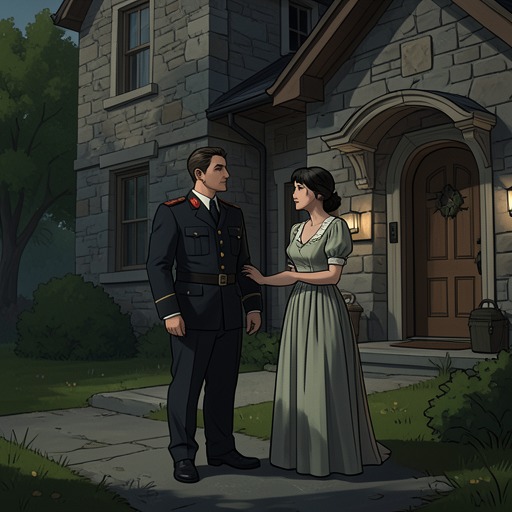
John Barrymore—Eliza Barrymore
The Hound of the BaskervillesJohn Barrymore and Eliza Barrymore are a married couple serving at Baskerville Hall whose loyalty to the household is tested by grief, suspicion, and Eliza’s devotion to her fugitive brother. Their secret nighttime care for Selden makes them seem threatening to Sir Henry, but the revelation of their motive recasts their concealment as an act of family protection rather than a plot against their new master.
Household Position and Shared Loss
John is the butler at Baskerville Hall, a tall, handsome man with a square black beard and pale, distinguished features. Eliza is presented as a solid, intensely respectable woman, outwardly reserved but capable of powerful feeling. Together they belong to a long-established household: Sir Henry understands their family to have served his own for generations, and John later says that their family has lived under the roof for more than a hundred years.
The couple’s attachment to the estate is bound up with their affection for Sir Charles. On Sir Henry’s arrival, John explains that he and Eliza had been deeply attached to the late master and that his death had shocked them. The house and its surroundings have become painful, and John doubts that they will ever again feel at ease there. He and Eliza contemplate establishing themselves in a business, with Sir Charles’s generosity having left them the means to do so. Their possible departure is therefore not simply a response to changed household arrangements: it follows a bereavement that has made continued residence difficult.
That history shapes the tension of their first dealings with Sir Henry. John offers to remain with him while he makes fresh arrangements, while warning that the house will need a larger staff under its new master. Sir Henry, reluctant to end an old connection at the beginning of his life at the Hall, asks whether the couple intend to leave. John’s answer expresses their grief, not disloyalty. Yet his formal reserve and private knowledge make him difficult for the new master to read.
Secrecy and Suspicion
Eliza’s sorrow is visible before its cause is known. Dr. Watson describes her as limited and intensely respectable, and finds her bitter sobbing on the first night at Baskerville Hall strikingly at odds with that appearance. He later notices traces of tears on her face. He wonders whether guilt haunts her or whether John is a domestic tyrant; these are Watson’s suspicions, not established facts. The uncertainty is sharpened by John’s own secret conduct.
One night Watson sees John moving barefoot through the corridor with a candle. John passes the balcony and enters an unoccupied room at the far end of the passage. There, he holds the candle against the window and watches the dark moor with rigid expectation. After several minutes he groans, puts out the light, and returns along the corridor. Watson hears a key turn later but cannot locate the lock. The candle at the window, the empty room, and John’s furtive movements suggest hidden communication, while Eliza’s unexplained tears make the household’s private distress seem potentially sinister.
When Sir Henry and Watson confront the couple, John appears ready to accept dismissal, insisting that the suspected plot was not directed against Sir Henry. Eliza then enters, pale and horrified, and interrupts the accusation. John tells her that the concealment is over and asks her to pack their things. She immediately takes responsibility, saying that he acted for her sake and at her request. The scene reveals a consequential difference between the couple’s roles: John has carried out the secret arrangements, but Eliza identifies herself as the person whose plea determined them.
Eliza’s Brother and the Night Signal
Eliza explains that Selden is her younger brother and that he is hiding on the moor after escaping prison. She recalls that, as a boy, he was indulged and allowed his own way; later, he fell in with bad companions and descended into repeated crime. His offences broke their mother’s heart and disgraced the family name. Although Eliza knows what he has become, she says that to her he remained the little boy she had nursed and played with as an elder sister. This attachment explains why she and John sheltered him when he arrived exhausted and hungry, with prison warders close behind.
The candle is part of an organized system of care. After Sir Henry’s return, Selden judged the moor safer than the Hall while the search for him continued. Every second night, John and Eliza used a light in the window to learn whether he was still nearby; an answering light showed that he remained, and John carried bread and meat out to him. They hoped each day that he had gone, but continued to feed him while he stayed. John had initially refused to disclose the secret because it was not his to tell; once Eliza has spoken, he confirms her account and stresses that the apparent plot was not against Sir Henry.
Their conduct thus joins marital cooperation to a conflict of obligations. John risks his position by carrying out the signaling and deliveries, while Eliza’s plea and kinship with Selden supply the reason. Their choice does not make Selden’s crimes disappear, and Eliza recounts his fall without denying it. Instead, her account distinguishes condemnation of his history from an elder sister’s refusal to let him starve at her gates. Watson’s earlier image of a potentially guilty or tyrannical household gives way to a more specific truth: grief and secrecy were present, but the hidden recipient of their care was Eliza’s brother.
Loyalty, Exposure, and Narrative Function
The couple’s concealment temporarily places them at odds with Sir Henry, who interprets the nighttime activity as a dark plot and reminds John of the family’s long service. Their loyalty is real, but it is divided: attachment to Sir Charles and the household coexists with a commitment to protect Selden. The revelation does not erase the danger of that divided allegiance; it clarifies its object and changes the meaning of the candle in the window from a possible threat into a signal of food and survival.
Their relationship also shows how much of the household’s life lies beyond the new master’s knowledge. John and Eliza occupy trusted domestic positions, yet their private movements and communications are initially invisible to Sir Henry and Watson. Eliza’s decision to speak, and John’s confirmation, turn that imbalance of information into an explanation of both the tears and the nocturnal journeys. Their story contributes a human counterpoint to the investigation: what looks like conspiracy can arise from loyalty, bereavement, and family attachment, though those motives do not prevent suspicion from taking hold.